Interview with Adrian Madoya, Emmanuel Okello, Robert Omondi, David Koimburi, Daniel Omulo
Special Mention of the 2025 Edition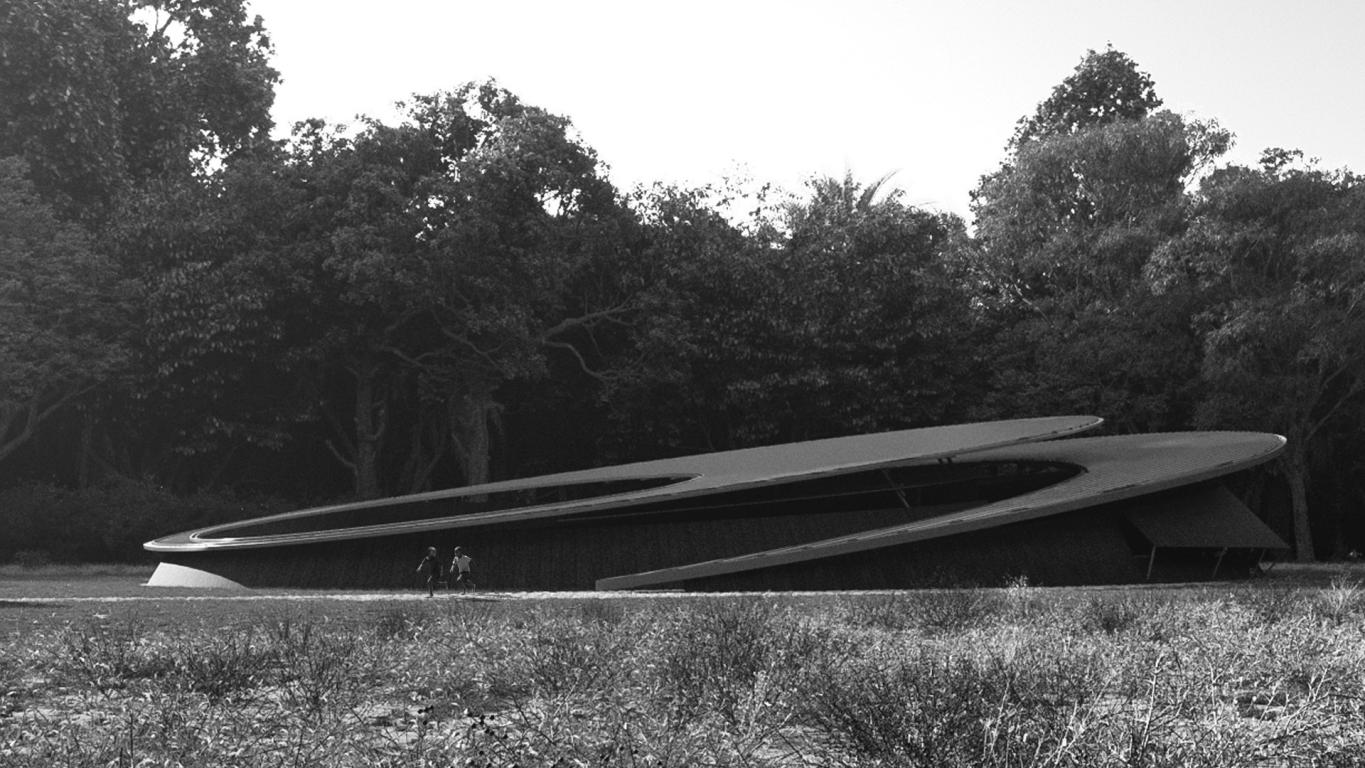
Can you briefly introduce yourself and your team?
My name is Adrian Madoya, a Kenyan self-taught architect extremely passionate about visualization, graphic design & illustration. I’m drawn to architecture that makes a statement through simplicity & on 1st impression. Therefore, I believe function follows form & that architecture must be poetic — it should stir something in you. I am the Principle Partner at LondonConsult, a Nairobi-based studio focused on concept & narrative-driven design. Our team includes Emmanuel Okello (CAD modelling), Robert Omondi (detail design), David Koimburi & Emmanuel Musikoyo (visualization), Billy Malel (technical illustration), Daniel Omulo (conceptual illustration) & Frank Ogol (quantity surveying). And no — London isn’t a geographical reference; it is cultural. The name is provocation — Nairobi slang for ideas so refined they feel foreign. We use it to prove they can come from here. This is our design ethos.
2. How did you feel when you received a Special Mention in the Kaira Looro 2025 competition?
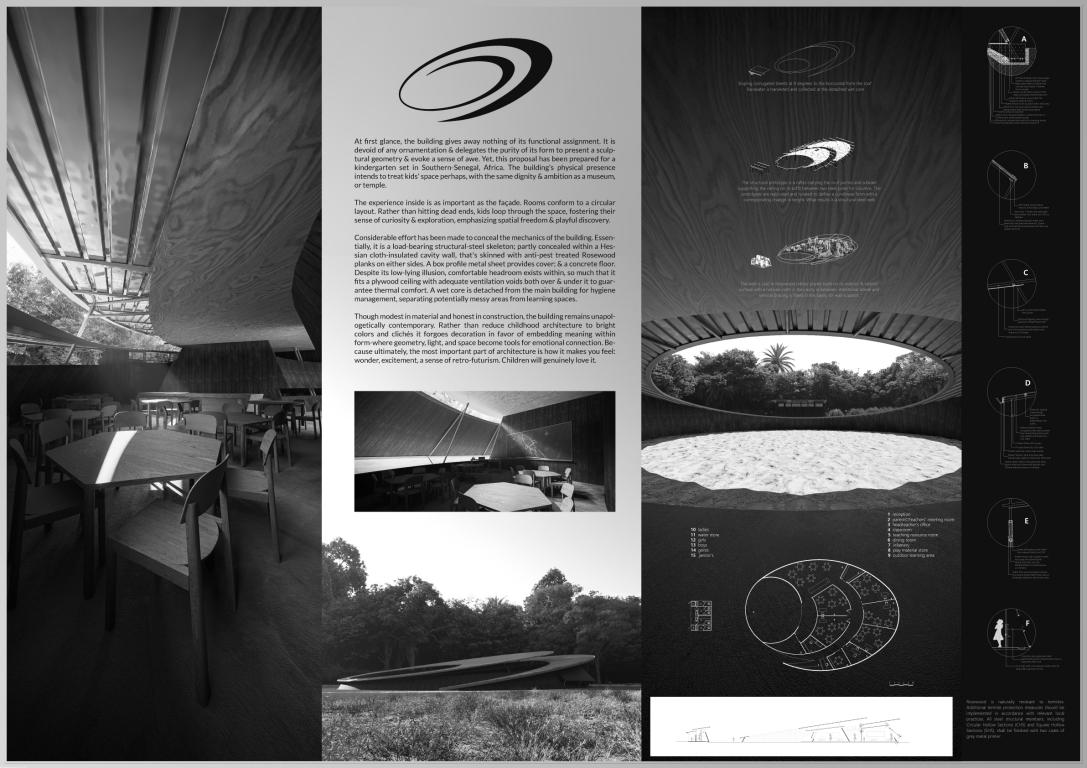
We did a nursery school in black & white; honestly, we were confident. We knew we’d submitted something grounded in meaning. But being reviewed—not by clients or peers—but by our idols, & having them say “this deserves recognition,” was emotional. Our work has often been met with skepticism. We’ve never broken ground on any of our disruptive design commissions. In Kenya, we’re told to scale down, make ideas more “realistic.” No matter how much we prove feasibility, people just don’t trust novelty. But here was an international starchitect jury saying: your boldness deserves recognition, watch out for these guys. We are the first-ever Kenyan team to be recognized in Kaira Looro’s history. Until now, vernacular-sensitive projects here—like Kéré’s Startup Lions or Urko Sanchez’s Waldorf School—were by international architects. With the win, that changed. Kenya joined the global vernacular design conversation—not as subject, but as author.
What inspired your project?
The project was inspired by 2 weeks spent with my 4-year-old niece, Chloe, during the holidays. It was the first time I’d spent that long with a child — & I noticed she loved anything that matched her scale; her small pink cup, toy kitchen set, her doll. She wouldn’t touch tea unless it was in her cup. She role-played as a parent & made me babysit her doll. I realized children are drawn to miniature versions of the adult world. I wanted to design a building that spoke to that — a structure that felt like it could only belong to children, yet was fully usable by adults, like a giant toy. My first sketch was a section; a child’s height on one end, connecting an adult’s on the other. Before starting, I profiled the jury’s design biographies. Curvilinear form stood out. So in section, the building follows a child’s scale; in form, it curves. The presentation was black-and-white — no distractions, just light, shadow & intent.
What does the theme of early childhood education mean to you?
Early childhood education, to me, is the most critical stage in shaping how a child sees themselves & the world. Children raised in confident, dignified environments grow up believing they’re allowed to dream — even when surrounded by hardships. That’s why this building had to feel otherworldly — like the galaxies, like orbit — to mark their memory forever. I wanted their first experience of architecture to be so ambitious that every space they encounter after, is measured against the wonder they once knew in kindergarten. Even if made from humble, rural materials, the message must be clear; elegance doesn’t need excess. The most powerful sophistication can exist in simplicity, clarity & precision. The space must whisper to them, even years later: your story began in a place that dared to dream for you.
What role can architecture play in supporting vulnerable communities?
Architecture, at its most powerful, gives form to dignity. Vulnerable communities are often excluded from beauty, permanence or boldness in design — yet these are precisely the values that affirm worth. Good architecture doesn’t just shelter bodies, it shapes identity. Design can challenge systemic neglect. It can provoke empathy, frame aspiration & show that everyone deserves more than survival — they deserve belonging & pride. Architecture can spark shared prosperity when it refuses to patronize & instead elevates. The built environment is never neutral. Ours is a message; even in places marked by scarcity, excellence is a right — not a luxury. For vulnerable communities, this kind of design can be transformative. It can shift mind-sets. In many African contexts, “beautiful” still means “foreign.” But good architecture can decolonize this — proving that excellence can emerge from what is local. It can awaken imagination & help people dream big with the little around them.
Did the humanitarian purpose of the competition influence your participation?
Definitely. In Kenya, meaningful vernacular or sustainable architecture is rare — often dismissed as a “poverty aesthetic.” Vernacular design is seen as backward, not aspirational. That’s a cultural problem, & few Kenyan architects engage it. Yet projects like Kéré’s Startup Lions or Urko Sanchez’s Waldorf School show what’s possible — even though both were authored by international architects. That’s why we joined Kaira Looro. We wanted Kenya to enter this global conversation, but as author. It also mattered to our studio’s trajectory, we’re often seen as a team that only handles high-budget work. This competition let us prove we’re ready for anything — even projects on a shoestring — as long as the client is brave. And we’re not limited to Nairobi. We’ll go wherever bold design is called for. This was London to the world.