Interview with Victor Iraola , Carlos Pesce , Gustavo Fuentes
Special Mention 2026
Could you briefly introduce yourselves and share your academic background and approach to architecture?
We are Uruguayan architects, and we see architecture as a discipline that begins long before the design process itself—it begins with listening, researching, and understanding the place for which we are designing. Our academic and professional background has allowed us to develop an approach in which technical knowledge and design coexist with a deep concern for the social, cultural, and environmental context. We are interested in creating a contemporary architecture that does not seek to impose itself on the territory but rather to engage in dialogue with it. We believe that the most meaningful architectural solutions emerge when design learns from local knowledge and transforms it into spaces that improve people's everyday lives.
What was your reaction when you learned that your project received a Mention in the Kaira Looro 2026 Competition?
It was a tremendous joy and, at the same time, a great professional satisfaction. This project was the result of an intensive research process, during which we sought to understand a reality very different from our own before beginning to design. Knowing that the jury appreciated this approach was especially meaningful to us. Beyond the recognition itself, we feel that this Honourable Mention confirms that architecture can be built upon respect, observation, and learning, and it encourages us to continue following this path in our professional practice.
During the design process, what were the main challenges you encountered?
The greatest challenge was designing for a context we had never experienced firsthand. From the outset, we understood that we could not respond to the brief based solely on our own experience; we needed to understand how communities in southern Senegal live and how their architecture has evolved in response to climate and ways of inhabiting space. During our research, we discovered the traditional dwellings organized around the impluvium. That discovery completely transformed our understanding of the project. We stopped thinking about designing a building and began thinking about creating a place of gathering, where community life and climate would become the true protagonists.
This year’s theme focused on a Community Centre for rural communities in Sub-Saharan Africa. What aspects of this brief did you find most inspiring or meaningful?
We were inspired by the opportunity to design a place that could become part of the community's everyday life. As we explored the traditional architecture of southern Senegal, we realized that the central courtyard was much more than an empty space; it was where family life unfolded, where daily activities were shared, and where rainwater acquired fundamental value. We found this way of understanding space to be remarkably contemporary. It led us to imagine a community centre whose true heart would not be a building, but an open space capable of bringing people together, offering protection, and strengthening social bonds. We also drew inspiration from the work of architect Francis Kéré for his approach to local materials, passive environmental comfort, and participatory construction. At the same time, this contemporary vision is deeply rooted in an important historical reference: the millennia-old earthen architecture of Mali and Sub-Saharan West Africa.
Could you briefly describe the main concept of your project and its intended impact on the community?
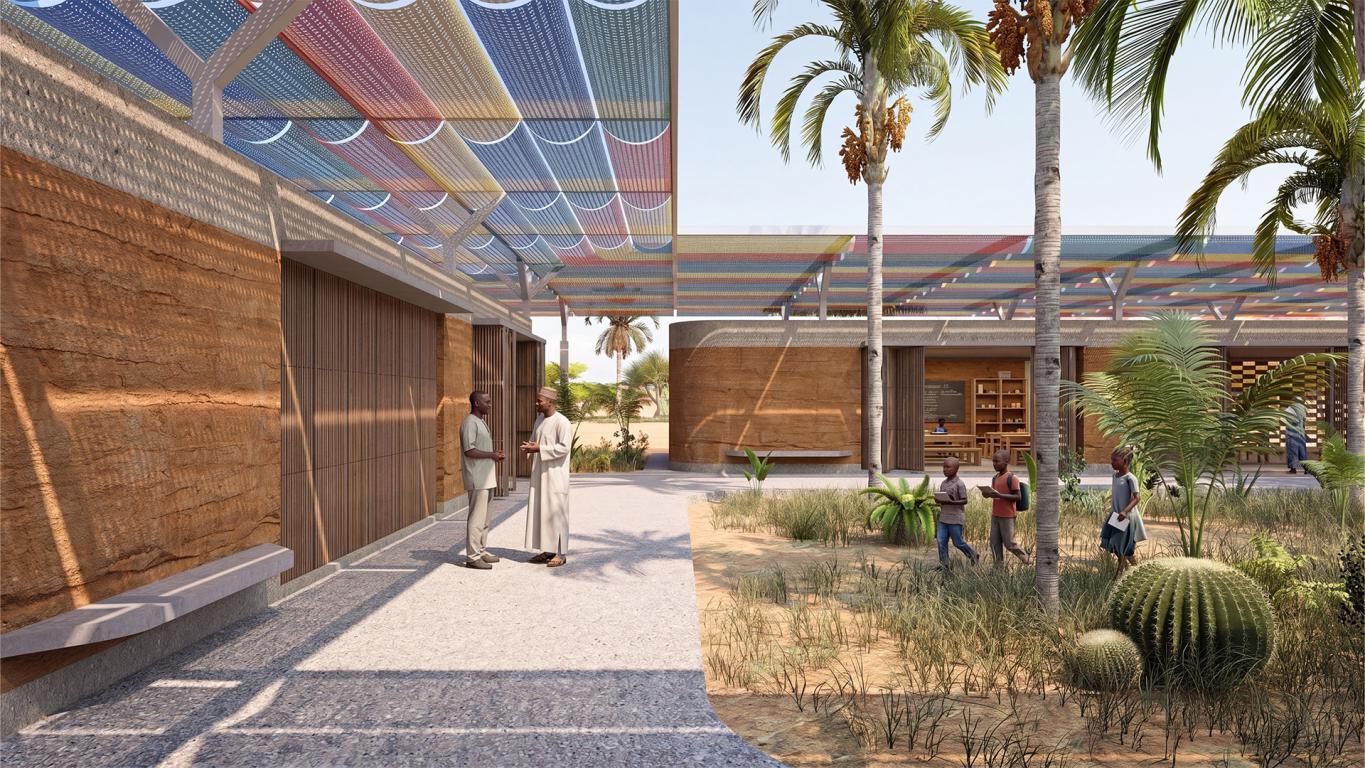
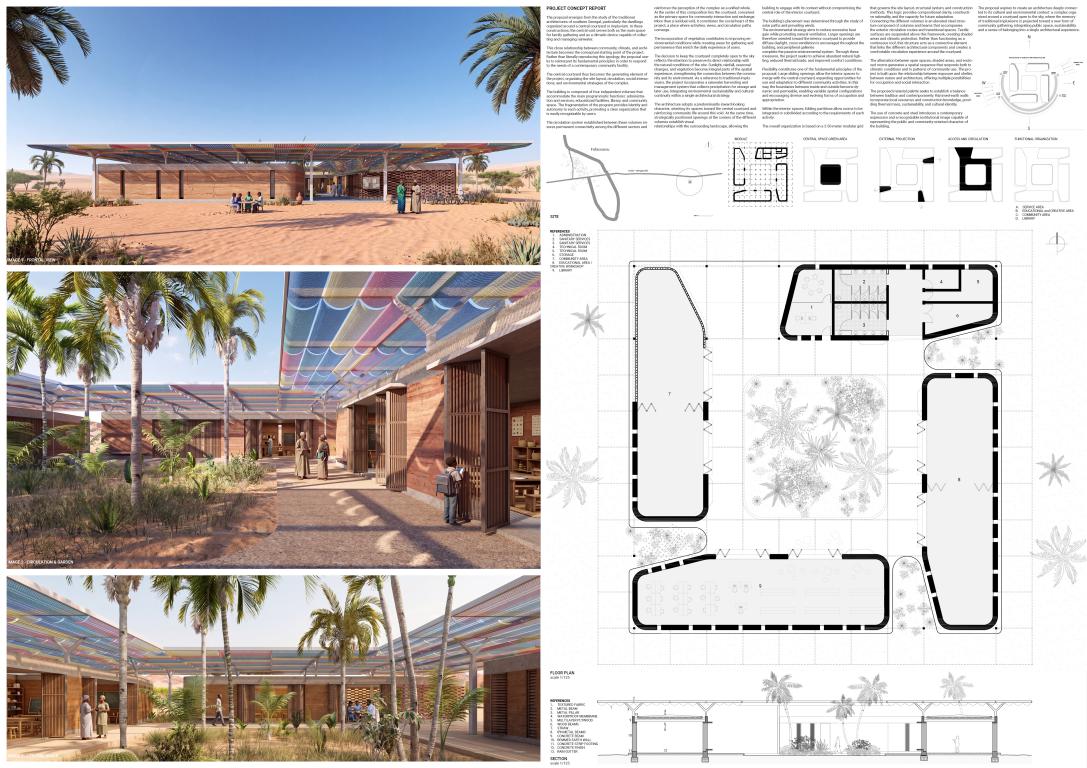
Our project reinterprets the impluvium as the organizing element of the entire complex. The central courtyard becomes the space where community activities converge while also functioning as a rainwater harvesting system and a natural regulator of environmental comfort. Around it, a series of independent volumes are connected by open circulation paths and shaded spaces that promote natural ventilation and encourage social interaction. Rather than simply constructing a building, our intention was to create a place that the community could truly make its own—flexible in its use and deeply rooted in the cultural identity of the territory.
How did considerations such as local materials, sustainability, and construction feasibility influence your design approach?
These aspects were never considered as isolated decisions but as parts of a single architectural vision. If the project emerged from learning from local traditions, it also needed to be built using materials and techniques consistent with that reality. For this reason, we prioritized the use of rammed earth, timber, and simple construction systems that could be built by local labour and easily maintained over time. Sustainability was approached through passive strategies such as natural ventilation, solar protection, and rainwater harvesting, demonstrating that responsible architecture can arise from simple decisions when the place is truly understood.
In your view, what role can architecture play in addressing social and humanitarian challenges today?
We believe that architecture cannot transform reality on its own, but it can create the conditions that make transformation possible. A thoughtfully designed space can foster education, social interaction, equality, and a sense of belonging. In contexts marked by major social challenges, the architect's first responsibility should be to listen before proposing solutions. Understanding a community's culture, climate, and ways of living is just as important as solving structural or programmatic issues. Architecture should emerge from research and attentive listening, becoming a tool that serves people rather than imposing itself upon them.
How does this recognition influence your motivation and your future direction as young architects or designers?
This Honourable Mention confirms that investing time in research before designing is worthwhile and that architecture rooted in its context can have a meaningful impact. It motivates us to continue developing projects in which design is the result of understanding a place rather than imposing preconceived ideas upon it. It also encourages us to continue participating in international experiences that allow us to learn from different cultures and broaden our understanding of architecture. We hope this recognition marks the beginning of a professional journey in which social commitment, sustainability, and respect for local identity remain the fundamental pillars of our work.